
11. Auxiliary Verbs

Section outline
-
Auxiliary or Helping Verbs are used with main verb to give grammatical meaning to the sentence.
Features:
- They help to form different tenses, moods, voices or add emphasis.
- It helps the main verb, as the main verb cannot stand alone to give complete meaning to the sentence.
- They are used to form questions & negatives.
- Auxiliary verbs change their forms to express different tenses.
- These verbs can be used as main verb (linking verb) but they are not action verbs.
Examples:
- Sam is playing in the garden.
- Are they coming for the party?
- She doesn't know the purpose of their visit.
Here,
- 'Playing, coming, know' are the main verbs.
- 'Is, are, doesn't ' are the auxiliary verbs.
- They are helping the main verbs, without which the sentence will be incomplete.
Example:
1. Tom is swimming in the pool.
Here, the verb 'is' is used as an auxiliary verb.
2. Tom is in the pool.
Here, 'is' is used as a main verb i.e. linking verb & not auxiliary verb.
-
Primary auxiliary verbs are a subset of auxiliary verbs.
There are three types of primary auxiliary verbs.
They are:
1. 'Be Verbs':
Form Positive verbs Negative verbs Singular am, is, was ain't, isn't, wasn't Plural are, were aren't, weren't 'Be' verbs also include: be, been, being
'Been' is the past participle & 'being' the present participle of the verb 'be' & are all used to form various tenses, to know more click here.
2. 'Have' Verbs:
Form Positive verbs Negative verbs Singular has hasn't I & Plural have haven't All had, having hadn't 3. 'Do' verbs:
Form Positive verbs Negative verbs Singular does doesn't I & Plural do don't All did didn't -
Shortened form of auxiliary verb is created when a auxiliary verb is combined with a pronoun or negatives or other words to form a more informal version.
They are often referred to as contractions,
These are commonly used in spoken English and informal writing.
Here's how auxiliary verbs are typically shortened:
Pronoun + Auxiliary verb Shortened form I am I’m I have I’ve I will I’ll we are we're they are they're you are you’re you have you’ve we have we’ve they have they've we will we'll he will he'll she will she’ll it has / is it’s she has / is she's he has / is he’s -
Auxiliary verbs have to be in agreement with singular & plural pronouns (subjects).
The following table shows the right usage of auxiliary verbs.
Pronoun / subject Auxiliary verbs I am, was, have, had, do, did he, she, it, singular nouns is, was, has, had, does, did you, we, they, plural nouns are, were, have, had, do, did The negative auxiliary verbs can be used with the respective pronouns where their positive equivalents are used.
For more details, refer to the course on subject verb agreement.
-
Auxiliary verbs change their form for past tense.
The following table will tell us which auxiliary verb is to be used in which tense.
Present tense Past tense am, is, are was, were have, has had do, does did The use of correct auxiliary verb is very important while forming tenses & for correct written & spoken English.
-
In this course, we learn't one of the most important & frequently used verb form, the 'auxiliary verbs'.
The primary auxiliary verbs are:
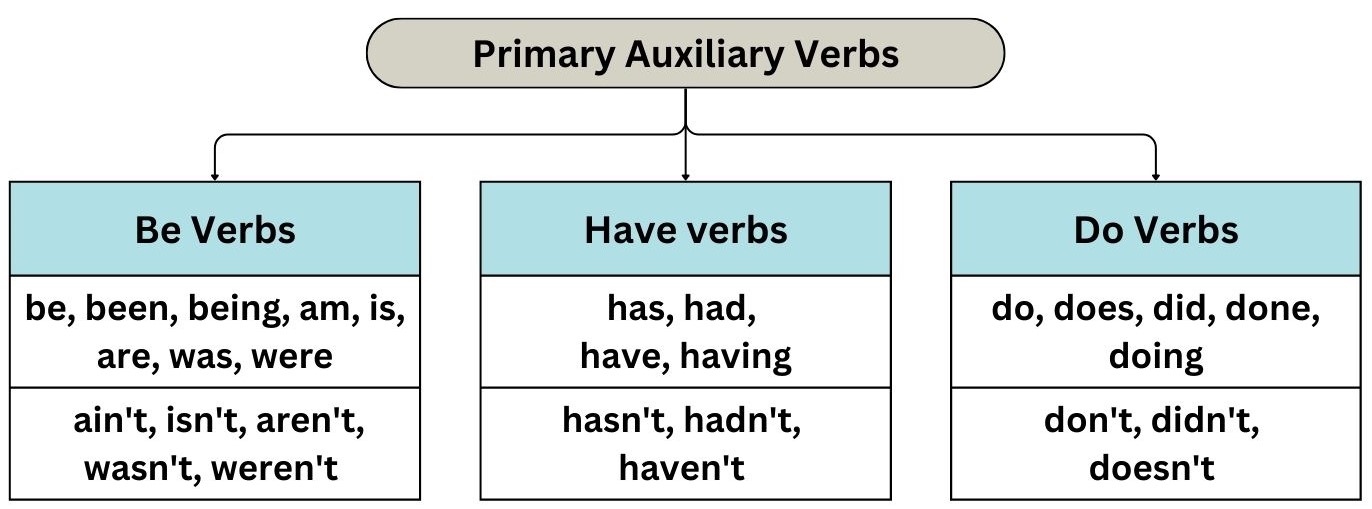
We also learn't the use of these verbs with different pronouns & tenses.
In the next course, we will learn about regular & irregular verbs.