
15. Non - Finite Verbs

Section outline
-
Non-Finite verbs are verbs which do not change they are form according to the:
- Tense (present, past & future)
- Number of people (singular, plural).
- Pronoun used as the subject (first, second or third person)
Examples:
- I like playing.
- He likes playing.
- She will like playing.
Here, the finite verb 'like' will change form with according to the pronoun or tense but the non-finite verb 'painting' remains unchanged.
Non-finite verbs cannot be the main verb.
Example:
The teacher was pleased with his work.
Here, 'was' is finite verb & 'pleased' is non-finite verb.
-
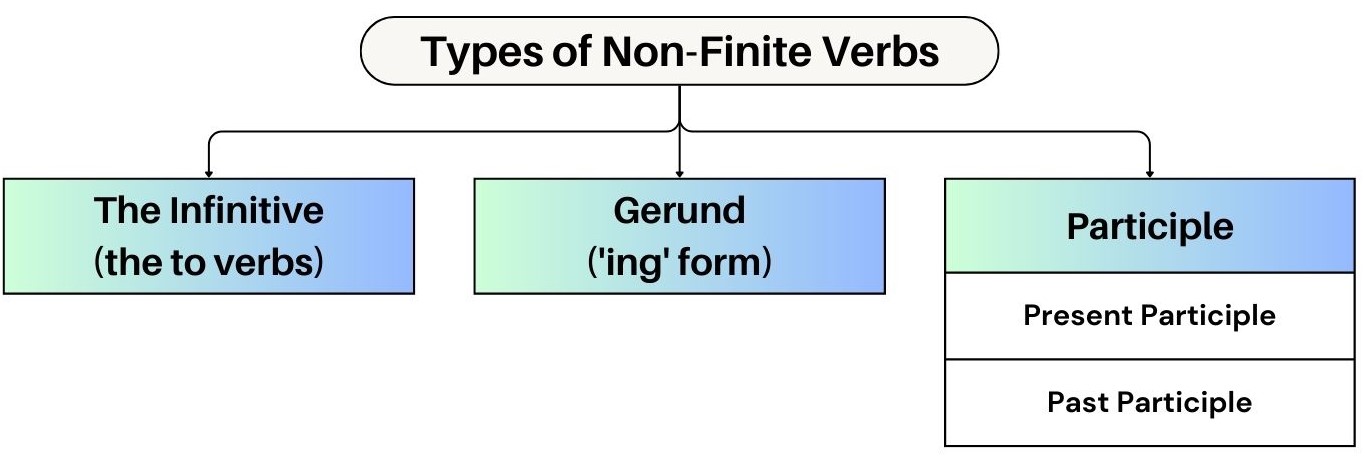
Non-Finite Verbs are of three types.
They are:
-
The infinitive are the to - verbs.
Structure of infinitives is:
to + base form of verb.
Examples:
- She wanted to discuss her plan.
- It is harmful to drink impure water.
-
Gerunds are 'ing' form of verbs that work as nouns.
Example:
Dancing requires a lot of practice.
Here,
- Dancing is a verb formed by adding 'ing' to the verb 'dance'.
- It is the subject of the sentence.
- It answers the question 'what requires a lot of practice.'
- It acts as a noun.
Features:
- As gerunds are verbal nouns (nouns derived from verbs).
- We can use articles, adjectives, possessive adjectives, etc. with them.
- A gerund can act as subject or object in a sentence.
Examples:
- The singing of the choir was beautiful. (article 'the' is used before gerund 'singing'.)
- Regular exercising keeps you healthy. (adjective 'regular' is used with gerund 'exercising'.)
- Running is fun. (subject)
- She enjoys reading. (object)
-
A Participle is a verb that functions as an adjective.
Examples:
- The running water was cold.
- She prefers cooked vegetables.
Here,
- The words 'running & cooked' act as adjectives.
- They describe the nouns 'water & vegetables'.
- 'Running' is formed by 'run (verb) + ing'.
- 'Cooked' is formed by 'cook (verb) + ed'.
Hence, they are participles.
Features:
- Participles are derived from verbs.
- They perform the work of verbal adjectives as they describe the noun.
- They help in creating verb tenses.
There are two types of participles.
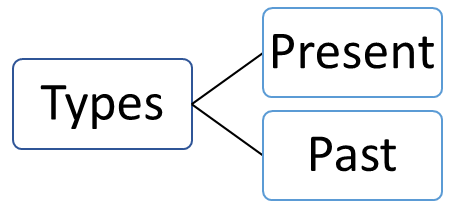
Let's understand each of them in detail.
-
In this course we learn't about:
- Non-finite verbs.
- How non-finite verbs are different from finite verbs.
- The Infinitives (to verbs).
- Bare Infinitives (verbs which dont use 'to' but are infinitives).
- Gerunds ('ing' verbs).
- Present participle ('ing' verbs).
- Past participle ('ed' verbs).
In the next course, we will learn all about tenses & how participles are used!