15. Non - Finite Verbs

Definition & Types
Section outline
-
Non-Finite verbs are verbs which do not change they are form according to the:
- Tense (present, past & future)
- Number of people (singular, plural).
- Pronoun used as the subject (first, second or third person)
Examples:
- I like playing.
- He likes playing.
- She will like playing.
Here, the finite verb 'like' will change form with according to the pronoun or tense but the non-finite verb 'painting' remains unchanged.
Non-finite verbs cannot be the main verb.
Example:
The teacher was pleased with his work.
Here, 'was' is finite verb & 'pleased' is non-finite verb.
-
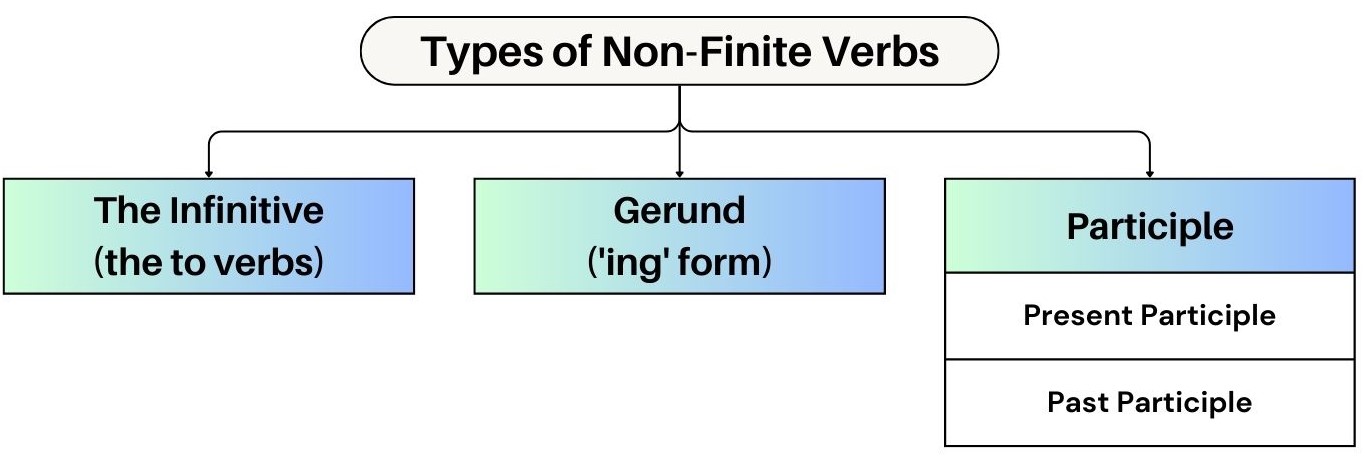
Non-Finite Verbs are of three types.
They are: