
17. Past tense

Section outline
-
Past Tense expresses actions that have already happened.
Examples:
- Tom played in the garden.
- They ran home.
Auxiliary Verbs used in Past Tense:
Subjects Verb Examples I, He, she, it, singular nouns was I / he / she was late. We, you, they, plural nouns were We / they were hungry. For all Subjects had You had a car. -
There are four types of past tense:
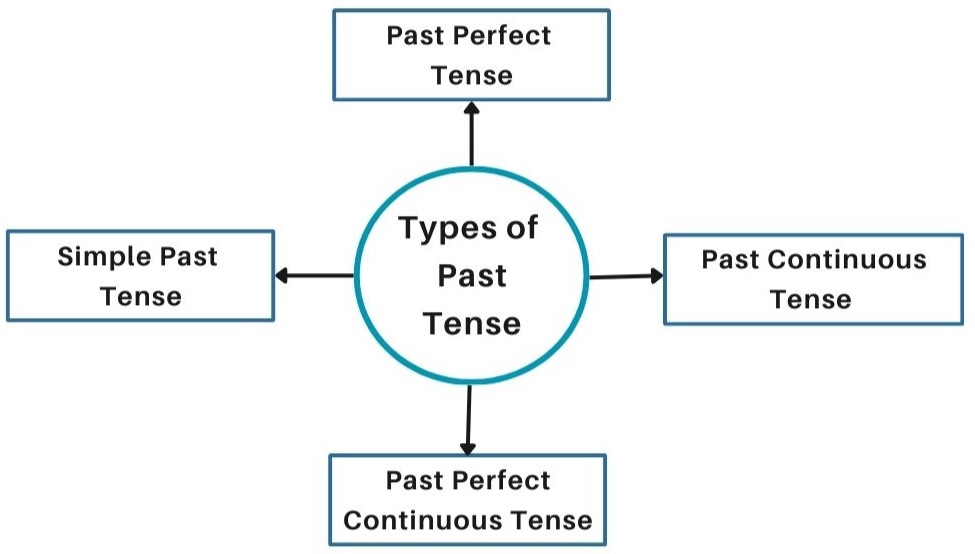
Let's study each of them in detail.
-
Simple Past Tense is the basic form of verb in past tense.
To form simple past tense:
Type of sentence Verb Examples Affirmative past tense We walked to the park. Negative didn't + base verb Jane didn’t go to the doctor. Interrogative did + subject + base verb Did Tom play the match? Didn’t they bring the flowers? Use:
To Express Examples Action that happened in the past. The children visited the park yesterday. Events happened in stories. Snow White ate the poisoned apple. Actions that have happened at definite time in the past. It rained last week. Past habit or repeated actions in the past. I always cycled to school. -
Past Continuous / Past Progressive Tense refers to actions happening at fixed time in the past.
To form past continuous tense:
Type of sentence Verb Examples Affirmative was / were + present participle He was going to the party. The boys were playing football. Negative wasn't / weren't + present participle I wasn't playing football. We weren't playing in the garden. Interrogative was / were + subject + present participle Was it raining yesterday? Weren’t you going to the party? For more information on present participle, click here.
Use:
To express Examples An action that was continuing in the past. The choir was singing carols. Background of story written in the past tense. When it was getting dark, the lion came. Unfinished action that was interrupted. We were walking when it started to rain. Change of mind that happened in the past. They were fighting but then they decided to stop. Two actions going on at the same time in the past. Jack was playing while Tom was cycling. Request using the word ‘wonder’. I was wondering if we could go out. Actions repeatedly happening in the past. She was always talking in the class. -
Past Perfect Tense refers to actions that have been completed in the past.
To form past perfect tense:
Type of sentence Verb Examples Affirmative had + past participle She had invited me for dinner. Negative hadn't + past participle Jane hadn’t gone to school. Interrogative had + subject + past participle Had they arrived for the game? For more information on past participle, click here.
Use:
To express Examples Sequence of events happened in the past. We had left the party before they arrived. A condition with its result. If I had slept on time, I would have reached the event on time. An event occurred short time before (used with 'just') The doctor had left for the day just before I arrived. -
Past Perfect Continuous / Progressive Tense refers to actions happening in the past & continued up until a specific time or event in the past.
This tense shows duration or continuity of an action.
To form past perfect continuous tense:
Type of sentence Rule Examples Affirmative had been + present participle She had been preparing for the exam all day. Negative hadn't been + present participle They hadn’t been living there for long. Interrogative had + subject + been + present participle Had Sam been studying all night? For more information on present participle, click here.
Use:
To express Examples An uninterrupted past action. Ira had been cooking all evening. Duration of action to a certain point My dad had been working in the bank for ten years, before he quit. Indirect Speech. She said that she had been waiting for him all evening. -
In this course, we learnt about past tense, which can be summarized as follows:
Rules to form past tenses:
Tense Rules Simple past past tense of verb Future Continuous was / were + present participle Future Perfect had + past participle Future Perfect Continuous had been + present participle Examples:
Simple Past Past Continuous Past Perfect Past Perfect Continuous I walked. I was walking. I had walked. I had been walking. He walked. He was walking. He had walked. He had been walking. They walked. They were walking. They had walked. They had been walking. In the next course, we will be learning about Future Tenses.