
18. Future tense

Section outline
-
Future Tense expresses actions that will happen or occur in the future.
Example:
- The children will be in the classrooms.
- I will be fine.
Auxiliary Verbs used in Future Tense are:
will / shall / will have / shall have
Examples:
- They will come tomorrow.
- I shall do this tomorrow.
- We will have a light dinner.
-
There are four types of future tense:
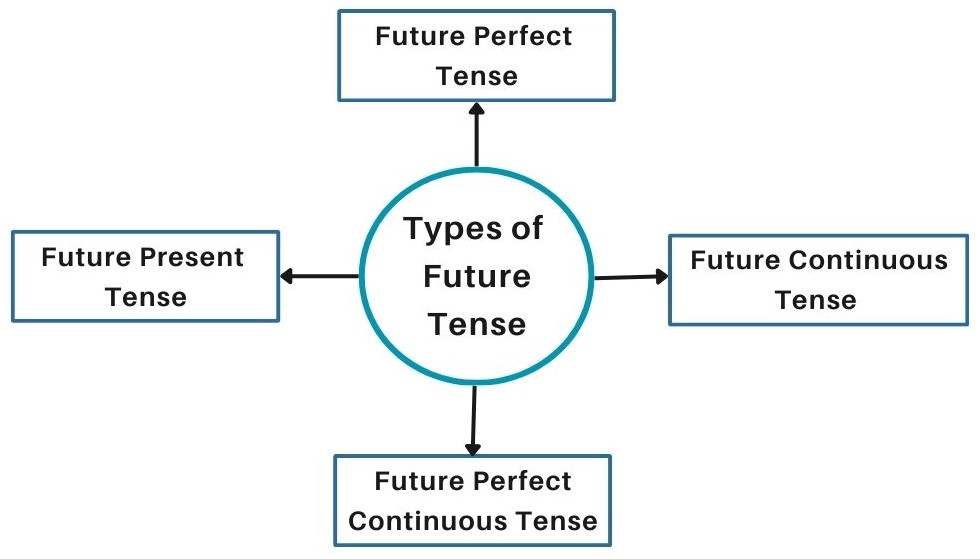
Let's study each of them in detail.
-
Simple Future Tense is basic form of future tense & refers to actions which are yet to happen.
To form simple future tense:
Type of sentence Verb Examples Affirmative will / shall + verb They will go for city tour tomorrow. Negative won’t + verb Sam won’t come to office. Interrogative will / Shall + subject + verb Will they come to the party? Use:
To Express Examples A future event. The wedding will take place next month. A spontaneous decision. I will pay in cash. Orders. You will do as I say. Willingness. I will help you with your homework. Offer, request, invitation or suggestion. Shall I close the door? Predictions, thoughts, fears or assumptions. It will rain heavily tomorrow. -
Future Continuous / Progressive Tense refers to an action that will be happening at a future time.
To form future continuous tense:
Type of sentence Verb Examples Affirmative will be + present participle She will be coming home tomorrow. Negative won’t be + present participle We won’t be coming to the party. Interrogative will + subject + be + present participle Will you be coming to the party? For more information on present participle, click here.
Use:
To Express Examples An action that will progress at a fixed time in future. We will be playing the match tomorrow at 10am. Predictions about the present. She will be appearing for her exams now. Future plans or intentions. We will be bringing her home in the next week. Parallel actions of future. I will be preparing breakfast and he will be going to the gym tomorrow morning. Future intentions. I will be playing tennis on weekends. -
Future Perfect Tense refers to an action that will continue till a specific time in future.
To form Future Perfect Tense:
Type of sentence Verb Examples Affirmative will have + past participle The grass will have grown by next week. Negative won’t have + past participle Sam won’t have seen it still. Interrogative will + subject + have + past participle Will she have taken the cake? For more information on past participle click here.
Use:
To Express Examples An action that will be completed in the future. We will have finished our exams by this time tomorrow. Action which will be finished before another action in the future. I will have cooked lunch before they arrive tomorrow. Actions that began in past and will be completed in future. They will have arrived at the party within an hour. -
Future Perfect Continuous / Progressive Tense refers to an action that will continue till a specific time in future.
To form future perfect continuous tense:
Type of sentence Verb Examples Affirmative will have been + present participle By next year, I will have been completing five years in this company. Negative won’t have been + present participle By next year, he won't have been playing for twenty years. Interrogative will + subject + have been + present participle Will she have been cooking? For more information on present participle, click here.
-
In this course, we learnt about future tense, which can be summarized as follows:
Rules to form tenses:
Tense Rules Simple Future will / shall + verb Future Continuous will be + present participle Future Perfect will have + past participle Future Perfect Continuous will have been + present participle Examples:
Simple Future Future Continuous Future Perfect Future Perfect Continuous I will walk. I will be walking. I will have walked. I will have been walking. He will walk. He will be walking. He will have walked. He will have been walking. They will walk. They will be walking. They will have walked. They will have been walking. In the next course, we will be learning about 'subject verb agreement' one of the most important topic of English Grammar!