
3. Sentences

Section outline
-
Sentence is a group of words that make complete sense by itself.
Features of a sentence:
- It has a verb.
- It has a subject & a predicate.
- It begins with a capital letter.
- It ends with a full stop (.) or exclamation mark (!) or question mark (?) depending on the type of sentence.
- The words are written in proper order.
- It follows the subject-verb agreement.
For a sentence to make complete sense it should have all the above features.
Example:
The I drank coffee. (This is not making any sense)
I drank the coffee. (This makes sense; hence is a sentence)
-
There are two main parts of a sentence: subject & predicate.
1. Subject tells us who or what the sentence is about.
Features:
- It tells us who is performing the action.
- It is usually a noun or pronoun.
- Simple subject: one subject.
- Compound subject: more than one subject.
2. Predicate tells us something about the subject or what the subject is doing.
Features:
- It starts with the verb.
- It contains objects, complements or adverbs, etc.
- It describes the subject or tells us about the action done by the subject.
- It may consists of one or many words.
Identification:
- Identify the verb.
- Ask who or what to the verb.
- That is the subject of the sentence.
- Remaining part including the verb is the predicate.
Example:
The children are playing in the garden.
Here,
- The children - subject (who)
- are playing in the garden - predicate
- are playing - verb
-
There are 4 types of sentences based on their function i.e. whether the sentence is a statement or asking a question.
These types of sentences have different punctuation marks at the end.
Their types & subtypes are:
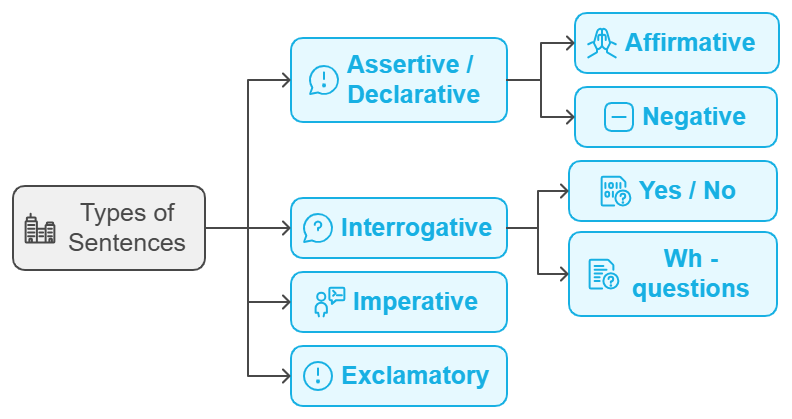
There are further 4 types of sentences based on their structure i.e. the types & number of clauses.
They are:
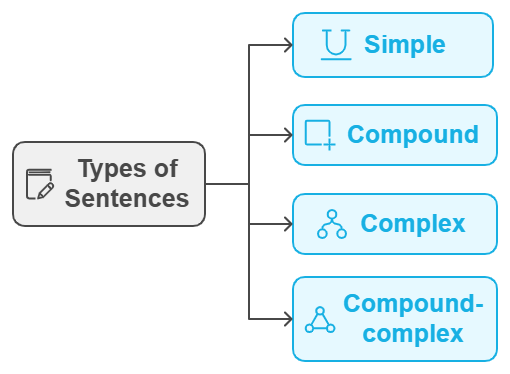
To understand these types of sentences, the concept of clauses should be understood clearly.
-
Assertive sentences are that which state or declare something.
Features:
- They are also called as declarative sentences.
- They always end in a full stop (.).
- They convey a fact or make a statement which can be positive or negative.
They are of two types:
1. Affirmative sentences:
Affirmative sentences state something that is true & positive.
Features:
- They affirm or make positive statement.
- They do contain any negatives.
Examples:
It is raining today.
The Earth revolves around the sun.
2. Negative sentences:
Negative sentences negate a statement or something.
Features:
- They show things that won't happen or don't exist.
- A affirmative statement is turned negative by adding 'not'.
- They contain words like 'no, not, nobody, nothing, etc.'
Examples:
The event is not happening today.
They are not coming here.
-
Interrogative Sentences are used to ask questions.
Features:
- We always put a question mark (?) at the end of interrogative sentences.
- The auxiliary verb always come before the subject.
Examples:
What are you eating?
Are you coming home?
Here auxiliary verb 'are' comes before the subject 'you'.
They are of two types:
1. Yes / No questions:
Features:
- The question always begins with an auxiliary verb.
- Answer can be only with a yes or no.
Example: Are you busy?
The answer for this question can only be 'yes' or 'no'.
2. Wh questions:
Features:
- Questions begin with 'where, what, whom, why, when, which or whose.'
- The above words are followed by an auxiliary verb.
- Answer to these questions is never a yes or no.
Example: What is the colour of your dress?
-
Imperative Sentences express commands, requests, offers, advices, instructions or suggestions.
Features:
- They end in full stop (.).
- They begin with a verb followed by subject.
- For requests, begin sentence with please followed by verb.
- For suggestions, sentence begin with subject followed by modal verb.
Examples:
Stop the game. (command / order)
Please open the door. (request)
Brush your teeth daily. (advice)
You can try this dress. (suggestion)
-
Exclamatory Sentences express feelings of surprise, appreciation or shock.
Features:
- They end in exclamation mark (!).
- They usually begin with words 'what or how'.
- For emphasis, the order of words is changed.
Examples:
What a beautiful day!
How lovely is the weather!
-
Types of sentence based on the structure:
For these types of sentences, we need to understand clauses in details.
1. Simple Sentences contain one independent clause.
Example:
She reads every night.
2. Compound Sentences contain two independent clauses joined by conjunction or semicolon (;).
Example:
She reads every night and he writes in his journal.
3. Complex sentences have one independent & dependent clauses joined by a subordinating conjunction.
Example:
She reads every night because it helps her relax.
4. Compound-Complex sentences have two independent & one dependent clauses connected by conjunctions.
Example:
She reads every night and he writes in his journal because it’s relaxing for both of them.
To summarize:
Type of sentence Independent clause Dependent clause Simple 1 0 Compound 2 0 Complex 1 1 Compound-Complex 2 1 * For details on independent & dependent clauses, click here.
-
In this course, we learnt:
- Constituents of a sentence.
- Types of sentences & their use.
- Importance of sentences.
Thus our foundation is ready, now let's explore the details of each component that form a sentence.
In our next course, we will learn in detail about the first component i.e. nouns.