
4. Nouns

Section outline
-
Nouns are words used to refer people, places, things & animals.
Importance of Nouns:
- Nouns are the most common parts of speech.
- They are the most important element to complete a sentence.
- Without nouns sentences will not have subjects and objects & become meaningless.
- They are the foundation of English language.
Examples:
People Place Things Animals Women Delhi Cake Birds Boy Cafe Train Fish Teacher Mall Books Lion Mr. Jack Airport Bag Crocodile Simpson Garden Chair Mosquito -
There are 11 types of nouns.
They are:
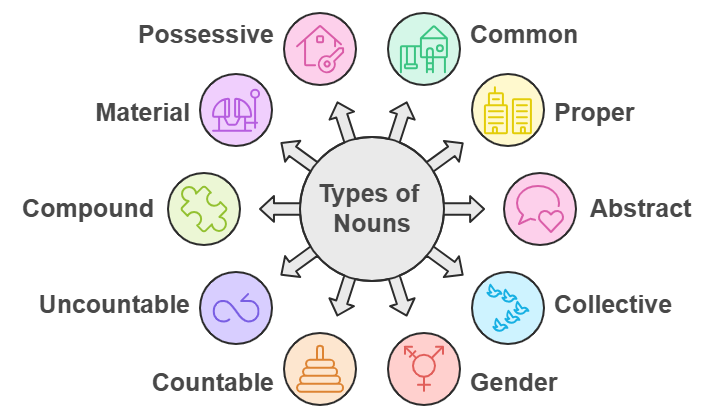
Let's understand each of them in detail.
-
Common Noun is a generic name to same kind of people, things, animals or places.
Examples:
Places garden, mall, road, village, city, mountain, river, etc. People women, man, girl, boy, child, baby, teacher, players, etc. Objects pen, pencil, paper, books, fuel, car, milk, phone, etc. Animals fish, elephant, bees, ant, lion, cat, etc. -
Proper Noun is a name given to a specific person, place, animal or object.
Features:
- They make common nouns special by giving them particular name.
- They help to distinguish common nouns.
- Proper Nouns always begin with a capital letter, wherever they appear in a sentence.
Examples:
Names of specific Examples People July, Jim, Jane, Wilson, etc. Places - city, country, town, continent Delhi, London, France, Irag, Asia, etc. Days of Week, Months Monday, December, etc. Seas, oceans, rivers, mountains Pacific Ocean, Mount Everest, etc. Festivals & special Days Christmas, Diwali, Independence day, etc. Books, Films, Newspaper The Lion King, Times, etc. Famous Buildings, monuments Taj Mahal, World Trade Centre, Eiffel Tower, etc. Organizations, Companies Microsoft, World Health Organization, etc. Titles President, Mayor, Prime Minister, Mr., Miss, Mrs., etc. Languages English, Hindi, Arabic, etc. Schools, Colleges & Universities Oxford University, Indian Institute of Technology, Public School, etc. Brand Names Pepsi, Ford, Tata, etc. Pets Tommy, Kitty, etc. -
Collective Nouns are group or set of people, animals or things taken together or as a whole.
Examples:
People Animals Things A crowd of people A shoal of fish A stack of chairs A board of directors A brood of chickens A flight of steps A band of musicians A pack of wolves A bunch of keys A gang of robbers A pride of lions A fleet of ships A team of players A colony of bats A deck of cards A crew of sailors A herd of elephants A collection of books A regiment of soldiers A parliament of owls A set of tools A choir of singers A swarm of bees A string of pearls A troupe of dancers A gaggle of geese A bouquet of flowers A class of students A flock of sheep A cluster of stars A family A caravan of camels A block of flats An orchestra of musicians A brood of chickens A collection of coins An audience An army of ants A constellation of stars With this lesson a detail list of most commonly used collective nouns is attached.
-
Abstract Nouns refer to concepts, feelings, ideas or things which can not be touched, felt or seen.
Features:
- They cannot be perceived by five human senses.
- They are something which is not physical.
- They are names given to a state of mind or quality or name of action.
Examples:
Freedom, happiness, sickness, childhood, bravery, honesty, wisdom, dance, growth, etc.
Abstract Nouns are formed by:
- Adding suffixes like -ry, -ness, -ship, -hood, -dom, etc. to adjectives, verbs or common nouns.
- Altering some letters of the original word.
Examples:
Common Nouns Adjectives Verbs child - childhood kind - kindness invent - invention student - study able - ability grow - growth servant - service brave - bravery learn - learning festival - festivity generous - generosity punish - punishment enemy - enmity confident - confidence heal - health friend - friendship poor - poverty break - breakage brother - brotherhood shy - shyness strike - stroke king - kingdom great - greatness think - thought infant - infancy deep - depth prove - proof thief - theft novel - novelty choose - choice agent - agency clever - cleverness live - life owner - ownership active - activity advise - advice member - membership free - freedom bear - birth priest - priestly coward - cowardice feed - food -
Material nouns are names of materials or substances that can be perceived by senses & are used as ingredients to make things.
Examples:
Copper, gold, glass, sugar, milk, air, water, etc.
-
Countable Nouns or countables are nouns that can be counted.
Examples: books, pen, cup, etc.
Uncountable Nouns or uncountables are those which cannot be counted.
Examples: milk, water, sugar, etc.
Difference between countable & uncountable Nouns:
Countable Noun Uncountable Noun They are in exact numbers.
Eg.: There ten books on the shelf.
They are not in exact numbers.
Eg.: Can I have some milk?
They have both singular & plural forms.
Eg.: There are so five babies here.
They have only singular form.
Eg.: Please put a little sugar in my tea.
They are usually common nouns.
Eg.: table, children, etc.
They are material, abstract & proper nouns.
Eg.: oil, honesty, India, etc.
To show quantity, use numbers / a / few / many, etc.
Eg.: Few candidates qualified for the next round of interview.
To show quantity, use some, little, much, any, etc.
Eg.: There is so much work today.
Some Important points:1. Nouns can be countable or uncountable depending on use in a sentence.
Example:
Sam just had one glass of juice now. (here glass is used as countable noun).
This vase is made of glass. (here glass is uncountable noun).
2. Some words used with material nouns may make them appear countable; but they still remain uncountable nouns.
Examples:
Give me five slices of bread.
The child had one cup of milk.
Here, 'bread & milk' are uncountable nouns but 'slices & cup' are countable nouns.
-
Possessive Nouns shows ownership or possession of things, relations, ideas, feelings or emotions.
They are generally represented by adding an apostrophe & 's' at the end of the noun showing ownership.
Rules for forming possessive nouns:
Rules Examples Singular nouns: add an apostrophe & ‘s’ at the end of the word. This is my dad’s new car. This is Bill’s favourite toy. Singular nouns ending with ‘s’: add an apostropheafter the ‘s’ This is James' / James's car. My boss' / boss's name is Mr. Hilton. Plural nouns ending with ‘s’: add an apostrophe after the ‘s’. The teachers' room is upstairs. Babies’ shoes are on the shelf. Nouns that share possession together: add an apostrophe & ‘s’, only to the last noun in the group. Mom and dad’s room is upstairs. This is Jack and Jill’s pail of water. Nouns that are together but have separate possession, add an apostrophe & ‘s’ to each noun separately. Ann’s & Jane’s dresses are pink and red. Ben’s and Bill’s offices are in the same building but on different floors. Nouns that refer to places, add an apostrophe and ‘s’ to the noun to whom the place belongs. The dentist’s clinic is on the next street. Sam’s Pizza serves fresh pizza. Hyphenated possessive nouns, add an apostrophe & ‘s’ at the end of the last word in the hyphenated word. My brother-in-law’s office is in the city. Compound possessive nouns, add an apostrophe & ‘s’ at the end of the compound word. The cowboy’s hat is very big. The trash can's lid is broken. Plural nouns, add an apostrophe & ‘s’ to make them possessive. The children’s picnic is tomorrow. There is a sale on women’s clothes. Important tips:
1. Always remember to put the apostrophe for possessive noun or else it will become a plural noun.
Example:
This is the girl's room.
(Here, if you write just girls without apostrophe, it will be a plural noun & entire meaning of the sentence will change)
2. Don't get confused between plural and possessive nouns.
Examples:All the rooms are cleaned in the morning.
(Here, rooms is used as plural as we are speaking of many rooms)
Please send me the room's photo.
(Here, a photo which belongs to a room is a possession of that room)
-
Compound Nouns are nouns made up of two or more different words.
The new word formed has a different meaning from the individual words that form it.
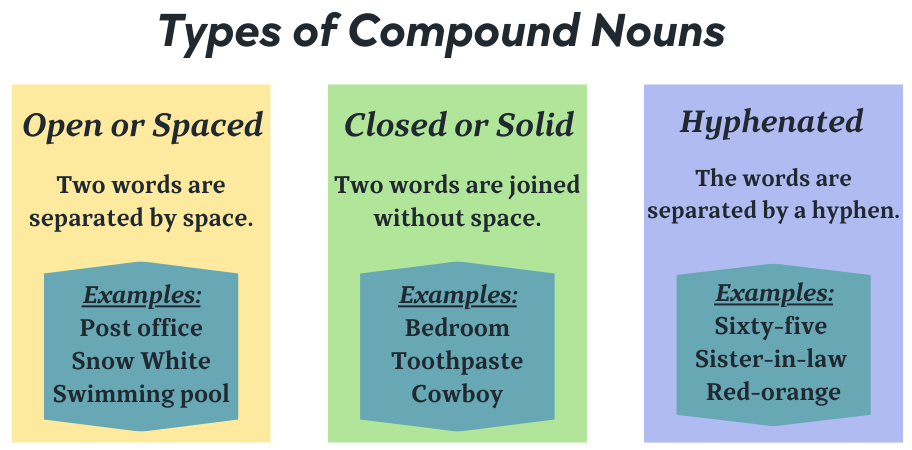
Words from different parts of speech are combined together to work as a compound noun.
Forming Compound Nouns:Combination Examples Noun + Noun Football, backbone, butterfly Noun + Verb Sunrise, haircut, healthcare Verb + Noun Runway, playground Noun + Adjective Snow White, town square Adjective + Noun High school, goldfish Adjective + Verb Dry-cleaning, long lasting Adjective + Adjective Red-orange, blue-green Noun + Preposition Hilltop, printout Preposition + Verb Outlook, intake Verb + Preposition Takeaway, makeup, check-out Preposition + Noun Underworld, online, upstairs -
Gender Nouns is way of classifying nouns on the basis of their gender.
Gender nouns of are of the following 4 types:
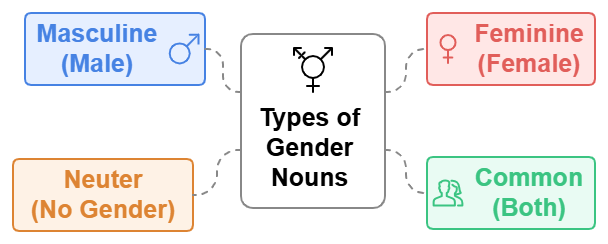
1. Masculine Gender:
It refers to words used for male people or animals.
2. Feminine Gender:
It refers to words used for female people or animals.
Male Female man woman lad / boy girl gentleman lady sir madam actor actress brother sister father mother son daughter master mistress nephew niece uncle aunt king queen wizard witch butler maid Mr. Mrs. / Miss emperor empress prince princess steward stewardess host hostess Male Female cock / rooster hen lion lioness tiger tigress bull cow fox vixen dog bitch drake duck gander goose stallion mare ram ewe tom queen buck doe drone queen / worker peacock peahen jack jenny boar sow cob pen leopard leopardess
3. Common Gender:It refers to words which are used for both males and females.
Examples:
Doctor, children. dancer, parents, teachers, etc.
4. Neuter Gender:
These are words refer to things that are neither male or female.
Examples:
Table, leaves, mirror, wind, ground, floor, cake, etc.
-
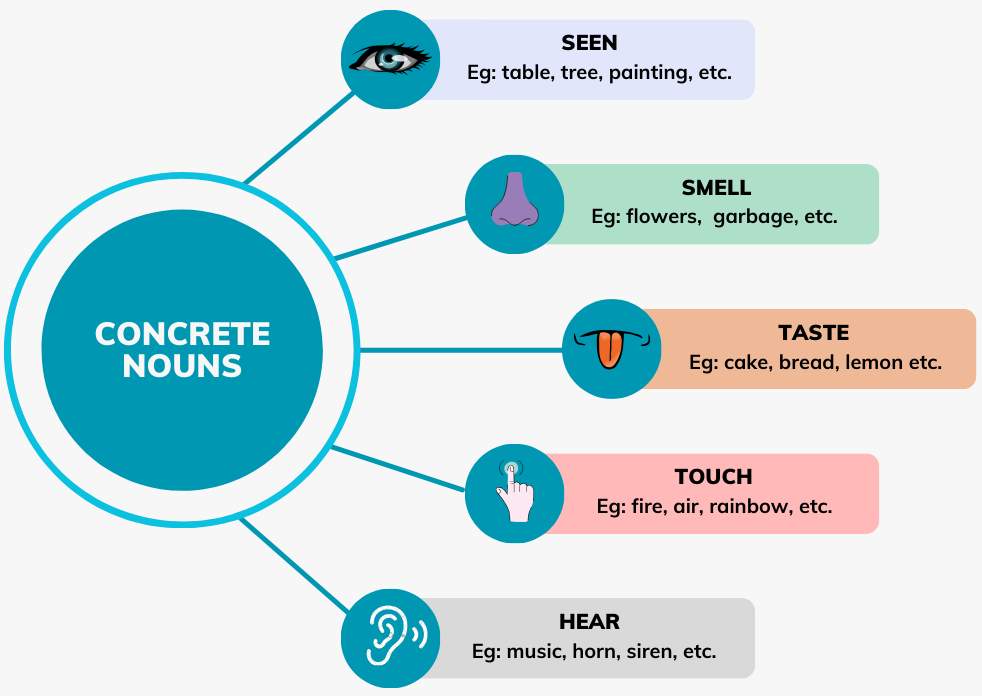
Concrete Nouns are things which can be perceived or sensed by the five senses i.e. touched, smelled, seen, tasted & heard.
Hence, these are tangible things in the physical world.
Examples:
-
In this course we learnt,
- How nouns help us label & describe the world around us, making them essential building blocks in English grammar!
- Identifying various types of nouns.
- Use of all types of nouns.
- Thus, nouns are the most fundamental part of English grammar.
In the next course, we learn singular & plural forms of nouns.