
29. Clauses

Section outline
-
A Clause is a group of words that forms a part of a sentence and has a subject & a finite verb.
Features:
- It has a subject , finite verb & predicate.
- A sentence can have more than one clauses.
- It is the building block of the sentence.
Examples:
- She thought that her book was lost.
- Jane is a girl with great courage.
The above clauses have their own:
- Subject - 'Jane, her book'
- Finite Verb - 'was, is'
-
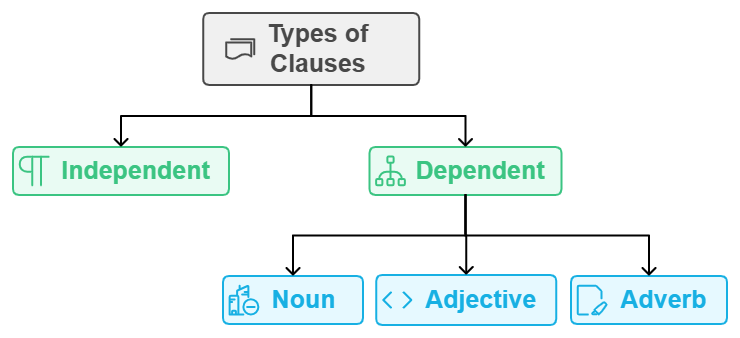
There are two major types of clauses.
They along with their sub types are:
-
Independent clause is a clause which makes complete sense & can stand alone.
Features:
- It can stand independently & is a complete sentence.
- It is also called the main or principal clause.
- It has a subject, finite verb & predicate of its own.
Examples:
- She sat in the park.
- The sun is shining.
- We ate lunch together.
-
A Dependent Clause is a clause that cannot stand on its own & is dependent on another clause in the sentence.
Features:
- It is also called as Subordinate Clause.
- It doesn't make any sense on its own.
- It has subject, finite verb & predicate.
- It depends on the independent or main clause to express itself.
Example:
Jill is a girl who carries herself with elegance.
Here,
- Jill is a girl - is the independent clause.
- who carries herself with elegance - is the dependent clause.
Some more examples:
Independent clause Dependent clause We stayed home because it was raining. I will go to the beach if the weather is nice. She sat in the park as it was pleasant. They liked the cake because it was delicious. There are three types of dependent clauses.
They are: Noun clause, adjective clause & adverb clause.
-
A Noun clause is a clause that performs the function of a noun.
Features:
- It acts as subject, object of the verb.
- It answers the question 'what' to the verb.
- It is introduced by using words like 'that, why, when what, if, etc.'
Example:
He said that he was in the party.
Here,
- 'He said' is the independent clause.
- 'That he was in the party' is the dependent noun clause.
- It answers the question 'what he said?'
- It is acting as the object of the verb 'said'.
Functions of a Noun clause:
1. As subject of verb: at beginning of the sentence.
Example:
What you said yesterday made me happy.
This is an subject noun clause of verb 'made'.
2. As object of verb: at the end of the sentence.
Example:
Jack said that he will join a driving class.
This is an object noun clause of the verb 'said'.
-
A Adjective clause is a clause that performs the function of a adjective.
Features:
- It describes the noun or pronoun.
- It is placed close to the noun or pronoun it describes.
- It answers the question 'which' to the verb.
- It is introduced by using words like 'that, who, which, where, etc.'
Example:
We are looking for a cat which is brown in colour.
Here,
- 'We are looking for a cat' is the independent clause.
- 'which is brown in colour' is the dependent adjective clause.
- It answers the question 'which cat?'
- It is describes the noun 'cat'.
Some important points:
1. Words 'who, whom' are used for living things.
Examples:
- This is the chef who cooks delicious food.
- The teacher, whom the students admired, retired last week.
2. Words 'which, that' are used for non-living things.
Examples:
- I read a book that was very interesting.
- She bought a dress which she plans to wear to the party.
3. Word 'where' is refers to place.
Example:
This is the house where I grew up.
-
An Adverb clause is a clause that performs the function of an adverb.
Features:
- It describes or tells more about the verb, adjective or adverb in the sentence.
- It can be placed before or after the main clause.
- If it is used in the beginning, use a comma (,).
- It connects with the main clause with an subordinating conjunction.
Example:
We stayed indoors because it was raining.
Here,
- 'We stayed indoors' is the independent clause.
- 'because it was raining' is the dependent adverb clause.
- It tells us more about 'why we stayed'.
- It is joined with the main clause by conjunction 'because'.
Let's see the various types of adverb clauses.
-
In this course, we learn't:
- Clauses are group of words that have a subject & predicate.
- They are part of the sentence.
- They consists of a finite verb.
- Difference between clauses & phrases.
- Types of clauses: Independent & dependent clauses.
- Types of dependent clauses: Noun, adjective, adverb.