
10. Action Verbs

Section outline
-
Action Verbs describe an action done by the subject of a sentence.
Features:
- They are dynamic / active words.
- They bring a sense of energy, direction & clarity.
- They describe both physical & mental actions.
Examples:
- Children played in the garden (physical action).
- We enjoyed the orchestra (mental action).
- She will announce the winners. (communication)
- The children painted the walls. (creative)
-
Actions verbs are of two types:
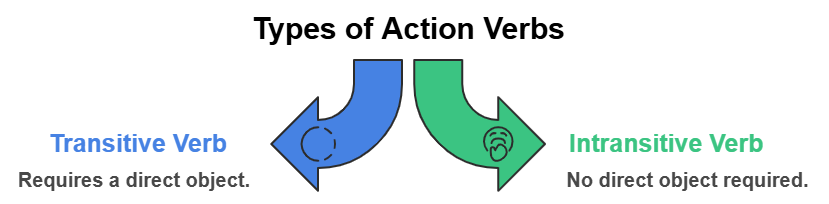
Intransitive Verb also include verbs of incomplete prediction.
-
Transitive Verbs require a direct object to complete its meaning.
Features:
- A noun or pronoun receives the actions.
- It is incomplete without a direct object.
- It can have an indirect object along with the direct object.
Example:
The girl opened the door.
Here, transitive verb 'opened' requires the object 'door' to make complete sense.
Transitive verbs also be used with two objects (direct & indirect).
Example:
She baked a cake for me.
Here, 'baked' is a transitive verb, which has two objects; 'cake' (direct) & 'me' (indirect).
-
Intransitive Verb do not require an object to complete its meaning.
Features:
- Intransitive verb is the main verb in the sentence.
- It can stand alone without an object.
- It does not transfer any action to an object.
- It may be followed by adverbs or prepositional phrases.
Example:
She reads.
Here, 'reads' is an intransitive verb as the sentence is complete by itself.
A verb can have both transitive and intransitive uses.
Example:
She eats an apple.
Here, ‘eats’ is a transitive verb as it has an object i.e. ‘apple’.
She eats slowly.
Here, ‘eats’ is intransitive because there is no object & ‘slowly’ is an adverb.
-
Incomplete Verbs or Verbs of Incomplete Predication require a complement of the verb to make complete sense of the sentence.
Examples:
The soup tastes delicious.
Here,
- 'Tastes' is the verb of incomplete predication.
- There is no action taking place.
- There is no object.
- But sentence is incomplete without the complement 'delicious' which is an adverb.
Features:
- They as they don't require any direct objects.
- They are a type of Intransitive verbs.
- But they can't stand on their own like intransitive verbs.
- They require a complement to make complete sense.
- The complement usually is an adverb or noun or adjective or preposition.
- They don't describe any action.
Examples:
- The sky is blue.
- He became an engineer.
- They felt happy.
-
In this course, we learn't:
- All about action verbs.
- Types of actions verbs.
- Transitive verbs are those that require a direct object.
- Intransitive verbs are those which don't require any object.
- Incomplete verbs are a type of intransitive verb which require a verb complement to make complete sense.
After exploring the world of action verbs, in the next course we will learn about auxiliary verbs.