
13. Modal Verbs

Section outline
-
Modal Verbs are type of verbs that are used with the main verb to express possibility, necessity, ability, permission, expectation & obligation.
Examples:
- May I sit here? (permission)
- You must finish your homework today. (obligation)
- He can swim. (ability)
- They should arrive by noon. (expectation)
Features:
- They are a type of auxiliary verb or helping verb.
- Thus, all modal verbs are auxiliary verbs by all auxiliary verbs are not modal verbs.
- They always come before the main verb.
- They cannot be there on their own in a sentence.
- Modal verbs do not change by change in the (first / second / third) person.
- Modal verbs do not change by change in number of person (singular / plural).
- Modal verbs have no 'ing' or 'ed' form.
- Negative sentences are formed by adding 'not' to the modal verbs.
- Main Verb after the modal verb is always used in its root form & past or present participle form of the verb is never used.
Examples:
1. I may visit my grandmother today.
Here, 'may' is the modal verb and 'visit' is the main verb. The sentence will make no sense without the main verb 'visit'.
2. I can write very fast. (first person)
You can write very fast. (second person).
They can write very fast. (third person & plural)
Here, the modal verb 'can' doesn't change form with person or number.
3. Tom cannot (or can't) go to the party tonight. (negative form)
-
The ten common modal verbs are:
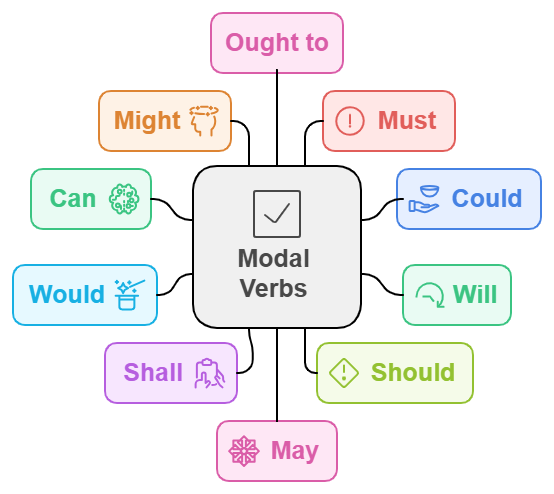
-
The modal verb 'could' is the past tense of the modal verb 'can'.
Use of verbs 'can & could':
To express Examples Ability or capacity I can walk up the hill. (present ability) I could run up the hill when I was a child. (past ability) Permission (seek & grant) Can he go home now? (seek) Yes, he can go home now. (grant) Could you go to the store? (past) Possibility It can rain now. (strong) It could rain in the evening. (weak) Offer Can I clean the room for you? Could I get you something to eat? Suggestion You can drop me home today. We could play after you finish your work. Request Can you please help me with the homework? Could you please pass those books? Negative Use We can't make it to the party tonight. We couldn't sleep on the flight. 'Could' as indirect speech You said that I could go for picnic. -
Use of modal verb 'shall':
To express Examples Future actions We shall go for the meeting tomorrow. A promise or assurance We shall do our bit for the country. Offer Shall I call the doctor? Suggestion Shall I open the door? An advice or confirmation Shall we go through the notes now? Obligation All parents shall pay the fees tomorrow. Will of the person Shall I get you a dress for the dinner? Command You shall follow the rules. -
It is the past tense of the modal verb 'shall'.
Use of modal verb 'should':
To Express Examples Future actions They should win the match. Past action I should have completed the work yesterday. Duty or obligation Children should obey their elders. Advice or recommendations Everyone should exercise regularly. We should use more renewable energy. Suggestion We should leave early to avoid traffic. Probability The restaurant should open soon. Logical deduction Tom should be late for the dinner due to the traffic. Prohibition (negative use) You shouldn't talk to strangers. -
Use of modal verb 'will':
To express Examples Simple future actions They will come for the wedding next week. Promise or assurance We will complete the project on time. Offer I will help you pack the food. Predictions There will be heavy rains tomorrow. Formal announcement of a future event. The Prime Minister will inaugurate the event next week. Willingness Sam will come for practice today. Invitation Will you come for my party? Habits She will always have her evening coffee here. Order or give instructions You will stay here until I return. All students will remain quiet during the prayer. Future decisions or intentions By next March we will be completing our college. Negative use They won't be coming for the party. -
It is past tense of the verb 'will'.
Use of modal verb 'would'.
To express Examples Past equivalent of verb 'will' They would go to the park if they had time. Future actions in the past The doctor said he would call me later. Preferences or desires I would prefer a cup of coffee. Request Would you please pass me the newspaper? Conditional or unreal situations I would read more if i had the time. Offer Would you like some more juice? Past habits Every Sunday I would visit my grandparents. Negative use I wouldn't mess with them. -
'Might' is the past tense of the verb 'may'.
Use of modal verbs 'may& might':
To Express Examples Permission (seek) May I borrow your book? Might I borrow your book? (rarely used) Grant of permission (conditional permission - use might) You may leave now. If you behave well, I might allow you to go to the party. Possibility She may go to the movie. (strong) She might come for the movie. (weak) Suggestion You may consult the teacher before you leave. You might like to meet the teacher before you leave. Past possibility (might) Tom might have missed the flight due to traffic. Prayers, wishes & hope (may) May you have all the happiness and peace in your life. May all your wishes come true. Negative Use They may not reach on time for the event. They might not not allow a late entry for the event. -
Use of modal verb 'must':
To express Examples Strong obligation You must wear a helmet while riding a bike. Duty The government must give primary education to all children. Necessity I must study for the exams. You must take your medicines immediately. Strong certainty She must have slept as the lights are off. Reason behind something He must be happy as he stood first in the class. Past action They must have taken the earlier flight. Prohibition You must not smoke in the room. Must is the strongest model verb of necessity.
-
Use of modal verb 'ought to':
To express Examples Advice or recommendation You ought to exercise every day to remain healthy. Moral obligation or duty You ought to help the poor and needy. Probability She ought to get promotion this year. Expectation The bus ought to arrive on time. Polite suggestion You ought to try the new pizza restaurant. Negative use You ought not to have said bad things about them. -
This course on modal verbs can be summarized as below:
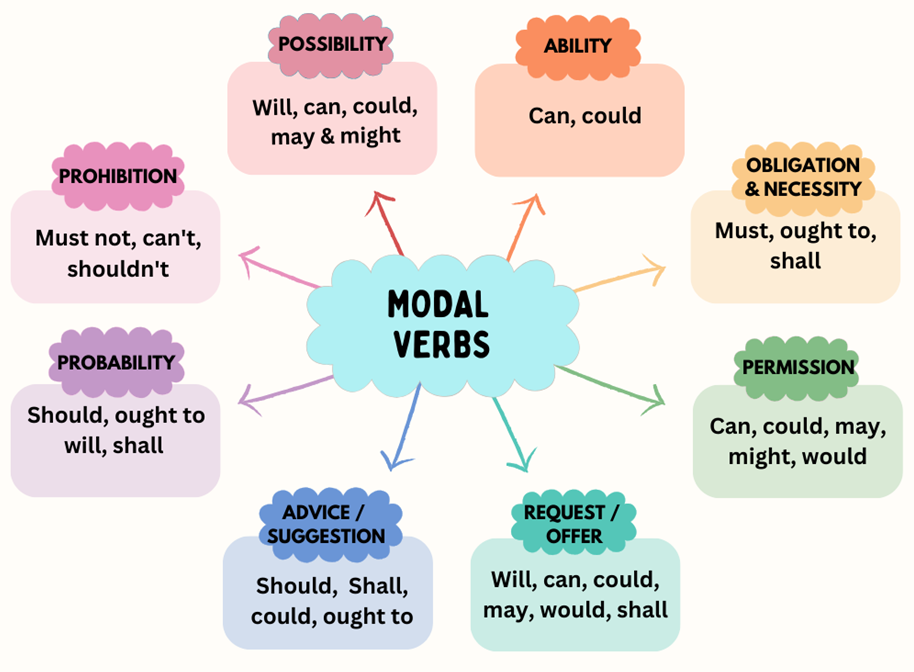
In the next course, we will learn about linking & phrasal verbs.