
26. Active & Passive Voice

Section outline
-
Voice indicates whether the subject is performing or receiving the action.
Voice which shows the relation between the subject & the action done by the verb.
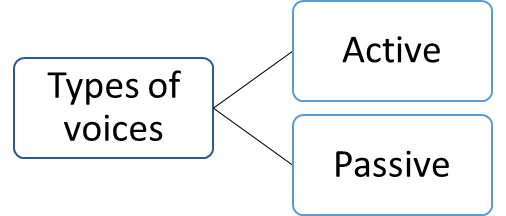
The two types of voices are:
-
Rules to convert active to passive voice:
-
Sentences with transitive verbs can only be changed into passive voice.
-
The object of the verb in active voice becomes the subject in passive voice.
-
The subject in active voice = by + agent (doer) in passive voice.
-
The form of verb changes as per the tenses.
Examples:
Active Voice Passive Voice Sam sung a song. A song was sung by Sam. Jane read a book. A book was read by Jane. Here,
- 'Sung, read' are transitive verbs.
- The objects 'song, book' in active voice changed to subjects in passive voice.
- 'Sam, Jane' are agents in passive voice.
5. Personal pronouns change in passive voice.
Examples:
Active Voice Passive Voice I ate an apple. An apple was eaten by me. She bought a book. A book was bought by her. List of change of personal pronouns is given below:
Active voice Passive voice I me we us he him she her they them Exception:
You & it remain same in passive voice.
6. Retain the interrogative form in passive voice.
Examples:
Active Voice Passive Voice Is she baking a cake? Is the cake being baked by her? Let's see the rules for changes in tenses in detail.
-
-
Rules to convert verb forms from active to passive voice for:
Simple present tense:
Active Voice Passive Voice base form of main verb is / am / are + past participle The teacher explains the story. The story is explained by the teacher. Present continuous tense:
Active Voice Passive Voice is / am / are + present participle is / am / are + being + past participle The boys are playing football. Football is being played by the boys. Present perfect tense:
Active Voice Passive Voice has / have + past participle has / have + been+ past participle He has told a story. A story has been told by him. -
Rules to convert verb forms from active to passive voice for:
Simple past tense:
Active Voice Passive Voice past tense was / were + past participle I told a story. A story was told by me. Past continuous tense:
Active Voice Passive Voice was / were + present participle was / were + being + past participle The boys were playing football. Football was being played by the boys. Past perfect tense:
Active Voice Passive Voice had + past participle had + been+ past participle Jane had told a story. A story had been told by Jane. -
Rules to convert verb forms from active to passive voice for:
Future past tense:
Active Voice Passive Voice will + base form will be + past participle I will tell a story. A story will be told by me. Exception:
Verbs in future continuous tense cannot be expressed in passive voice.
Future perfect tense:
Active Voice Passive Voice will + have + past participle will + have been + past participle Jane will have told a story. A story will have been told by Jane. * Shall can be used instead of will in above rules wherever required.
-
Rules to convert active to passive voice for interrogative sentences:
- Retain the question form in passive voice also.
- Change the object to subject & subject to object.
- Add 'by' before the original subject, if required.
- Change verbs 'do, did, does' to 'are, was, were'.
- Change verbs 'have / has' to 'have / has been + past participle of the main verb.'
- For 'wh-questions', retain the question word.
Examples:
Active Passive Did she eat the pie? Was the pie eaten by her? Have you washed the clothes? Have the clothes been washed by you? Have they completed the report? Has the report been completed by them? Who made this painting? By whom was this painting made? Why have they canceled the party? Why has the party been canceled by them? -
In this course, we have learn't:
- Voice is all about expressing who is doing the action.
- Voice is divided into active & passive voice.
- Active voice gives importance to the doer of the action.
- In passive voice, the action is more important than the doer.
- Rules for conversion of active voice to passive voice.
- Change of verb forms for various tenses while converting active to passive voice.
- Changes in interrogative sentences for change from active to passive voice.
In the next course, we'll learn how to convert direct speech to indirect speech.