
20. Adverbs

Section outline
-
Adverbs are words that describe or modify the verb, adjective or another adverb in a sentence.
Examples:
1. The boy walked slowly.
Adverb 'slowly' shows how the boy 'walked' (verb).
2. The teacher spoke very rudely.
Adverb 'very' tells more about adverb 'rudely'.
3. The queen is really kind.
Adverb 'really' tells more about adjective 'kind'.
Adverbs also have degrees of comparison same like the adjectives.
-
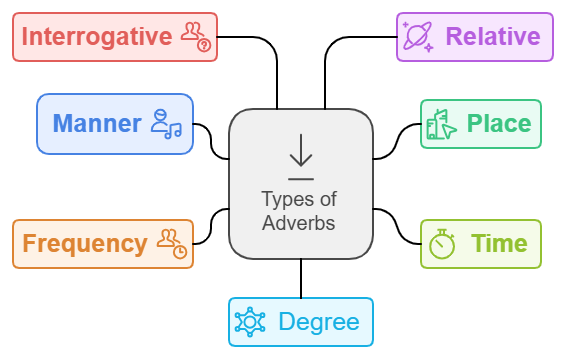
There are seven major types of adverbs.
They are:
-
-
Adverbs of manner tell us how or in what manner an action is done.
Features & position:
- It answers the question 'how'.
- It is placed after the main verb or direct object (if sentence has one).
- If the sentence has an auxiliary verb, then it is placed between the main & auxiliary verb.
Examples:
- The team played skillfully.
- He picked up the glasses carefully.
- They were happily watching the show.
In these examples:
- The words 'carefully, skillfully, happily' are adverbs of manner.
- Adverb 'skillfully' is placed after the main verb 'played'.
- Adverb 'carefully' is placed after the object 'glasses'.
- Adverb 'happily' is placed between the auxiliary verb 'were' & main verb 'watching'.
Let's understand the rules to form adverbs of manner.
-
Adverbs of place tell us the place where an action took place.
Features & position:
- It answers the question 'where'.
- It is generally placed after the main verb or direct object (if the sentence has one).
- If it ends with 'wards or ways' show movement in a specific direction (eg.: northwards, backwards, inwards, sideways, etc.)
Examples:
- We live here.
- Sam looked for his dog everywhere.
The words 'everywhere, here' are adverbs of place. They describe the where the action is done.
Common examples of adverbs of place are:
here, away, out, outside, nowhere, somewhere, in, inside, everywhere, upstairs, there, etc.
-
Adverbs of time tell us about the time or duration of action.
It answers the question 'when'.
Examples:
- She went to the doctor yesterday.
- The children will come later.
The words 'yesterday, later' are adverbs of time.
They describe the when the action is done.
Commonly examples of adverb of time are:
early, later, now, then, today, tomorrow, ago, recently, afterwards, soon, till, nowadays, yet, later, etc.
Adverb phrases of time:
Phrases like: by now, at once, till now, till today, etc. are called adverb phrases of time.
-
Adverbs of degree tell us about the intensity of an action.
Features & position:
- It answers the question 'how much'.
- It is placed before the verb, adjective or adverb.
- It modifies the verb or adjective or adverb with which it is used.
Examples:
- They almost finished the assignment.
- The boy nearly fell from the tree.
The words 'almost, nearly' are adverbs of degree & tell us more about the verbs 'finished & fell'.
Common examples of adverbs of degree are:
very, fully, almost, fairly, extremely, only, too, hardly, etc.
-
Adverbs of frequency tell us how often an action occurs.
Features:
- It answers the question 'how often'.
- They are placed before the main verb.
- Or between the main & auxiliary verb.
Examples:
- I often go to the park.
- They rarely eat junk food.
- She is regularly coming to school.
The words 'often, rarely, regularly' are adverbs of frequency which are telling us how often the action is being done.
Common examples of adverbs of frequency are:
seldom, sometimes, every time, usually, etc.
-
Interrogative adverbs are used to ask questions.
They are placed at the beginning of the sentence.
Interrogative adverbs & their use:
- Why are you happy? (reason)
- How long did you wait? (time)
- Where is your house? (place)
- How to you travel to office? (manner)
- When is your birthday? (time)
- How much do you have to work? (degree)
- How often do you visit the church? (frequency)
-
Relative adverbs connect a dependent clause to an independent clause.
Features:
- It helps to refer back to subject that dependent clause refers to.
- It functions like conjunctions by joining clauses.
- Relative adverbs are: where, when, why & whenever.
Examples:
- This is the house where I grew up.
- I remember the day when we first met.
- She doesn't know the reason why he left early.
- They stay indoors whenever it rains.
-
In this course, we learnt all about adverbs.
Different adverbs can be summarized as follows:
Adverb of Examples Manner together, sadly, alone, quietly, well, etc. Place here, away, outside, in, inside, everywhere, upstairs, there, etc. Time early, later, now, then, today, tomorrow, ago, recently, later, etc. Degree very, fully, almost, fairly, extremely, only, too, hardly, etc. Frequency seldom, sometimes, every time, usually, rarely, often, etc. Interrogative why, where, how often, when, etc. Relative where, when, why & whenever In the next course, we'll learn about joining words & sentences with appropriate conjunctions.