
12. Symmetry

Textbook Solutions
Section outline
-
-
Solutions to Ex. 12.1
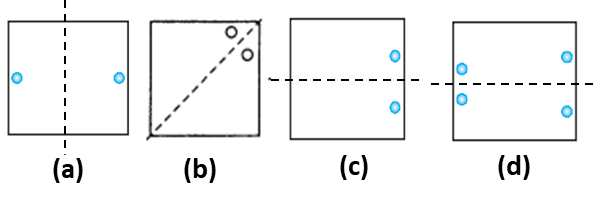
Q1. Copy the figures with punched holes and find the axes of symmetry for the following:
Ans:
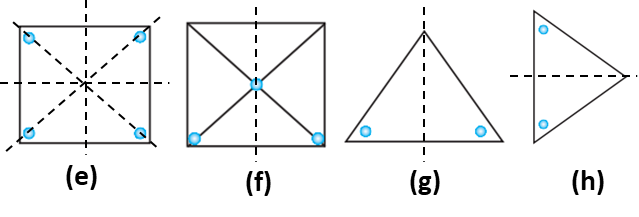
Q2. Given the line(s) of symmetry, find the other hole(s):
Ans:
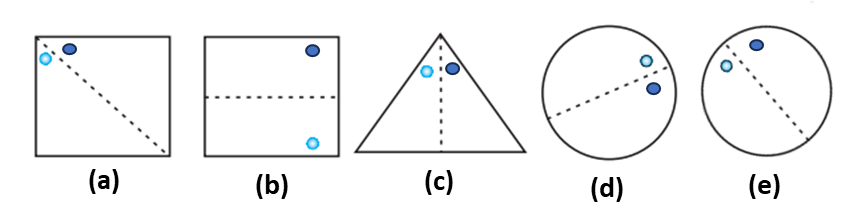
Q3. In the following figures, the mirror line (i.e., the line of symmetry) is given as a dotted line. Complete each figure performing reflection in the dotted (mirror) line.
Ans:
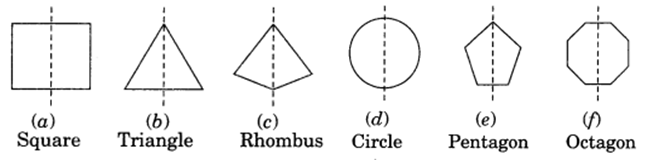
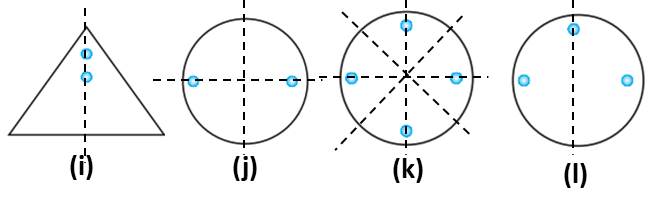
Q4. The following figures have more than one line of symmetry. Such figures are said to have multiple lines of symmetry. Identify multiple lines of symmetry, if any, in each of the following figures:
Ans: Figures a, b, c, d, e, g, h have multiple line of symmetry.
Q5. Copy the figure given here. Take any one diagonal as a line of symmetry and shade a few more squares to make the figure symmetric about a diagonal. Is there more than one way to do that? Will the figure be symmetric about both the diagonals?
Ans:
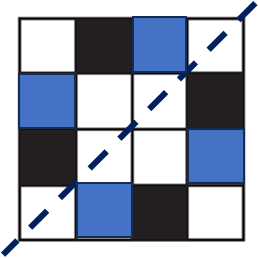
Yes, there are more than one ways to make the figure symmetrical.
Yes, the figure will be symmetrical about both the diagonals.
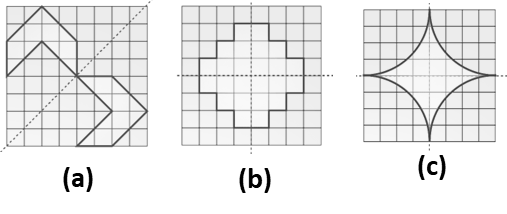
Q6. Copy the diagram and complete each shape to be symmetric about the mirror line(s):
Ans:
Q7. State the number of lines of symmetry for the following figures:
Ans:
(a) An equilateral triangle: 3 lines of symmetry.
(b) An isosceles triangle: 1 line of symmetry.
(c) A scalene triangle: No line of symmetry.
(d) A square: 4 lines of symmetry.
(e) A rectangle: 2 lines of symmetry.
(f) A rhombus: 2 lines of symmetry.
(g) A parallelogram: No line of symmetry.
(h) A quadrilateral: No line of symmetry.
(i) A regular hexagon: 6 lines of symmetry.
(j) A circle: Infinite lines of symmetry.
Q8. What letters of the English alphabet have reflectional symmetry (i.e., symmetry related to mirror reflection) about:
Ans:
(a) A vertical mirror: A, H, I, M, O, T, U, V, W, X, Y
(b) A horizontal mirror: B, C, D, E, H, I, O, X
(c) Both horizontal and vertical mirrors: H, I, O, X
Q9. Give three examples of shapes with no line of symmetry.
Ans:
A parallelogram, scalene triangle & quadrilateral have no line of symmetry.
Q10. What other name can you give to the line of symmetry of:
Ans:
(a) an isosceles triangle: Median or altitude
(b) a circle: Diameter
-
Solutions to Ex. 12.3
Q1. Name any two figures that have both line symmetry and rotational symmetry.
Ans:
- Equilateral triangle &
- Circle
Q2. Draw, wherever possible, a rough sketch of:
Ans:
(i) a triangle with both line and rotational symmetries of order more than 1.
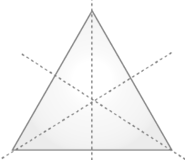
An equilateral triangle.
(ii) a triangle with only line symmetry and no rotational symmetry of order more than 1.
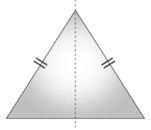
An isosceles triangle.
(iii) a quadrilateral with a rotational symmetry of order more than 1 but not a line symmetry.
Not possible to draw.
(iv) a quadrilateral with line symmetry but not a rotational symmetry of order more than 1.
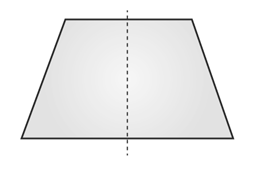
An isosceles trapezium.
Q3. If a figure has two or more lines of symmetry, should it have rotational symmetry of order more than 1?
Ans: Yes
Q4. Ans:
Shape Centre of Rotation Order of Rotation Angle of Rotation Square Point of intersection of diagonals 4 90o Rectangle Point of intersection of diagonals 2 180o Rhombus Point of intersection of diagonals 2 180o Equilateral triangle Point of intersection of medians 3 120o Regular Hexagon Point of intersection of diagonals 6 60o Circle Centre Infinite Every angle Semi-circle Centre 2 180o
Q5. Name the quadrilaterals which have both line and rotational symmetry of order more than 1.
Ans:
The quadrilateral which have both line and rotational symmetry of order more than 1 is a square.
Q6. After rotating by 60° about a centre, a figure looks exactly the same as its original position. At what other angles will this happen for the figure?
Ans:
The other angles are: 120°, 180°, 240°, 300°, 360°.
Q7. Can we have a rotational symmetry of order more than 1 whose angle of rotation is:
Ans:
(i) 45°: Yes
(ii) 17° : No
-