
6. The Triangle and its Properties

Textbook Solutions
Section outline
-
-
Solutions to Ex. 6.1
Q1. In ∆ PQR, D is the mid-point of QR.
Ans:
PM is the altitude.
PD is the median.
No, QM is not equal to MR.
Q2. Draw rough sketches for the following:
Ans:
(i)
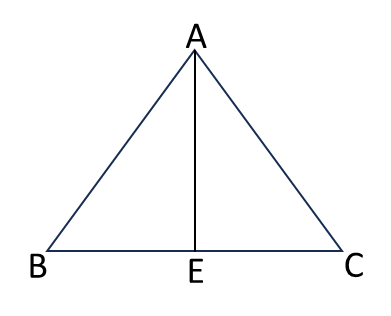
(ii)
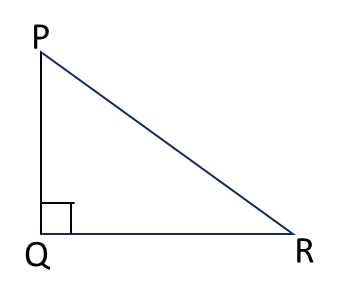
(iii)
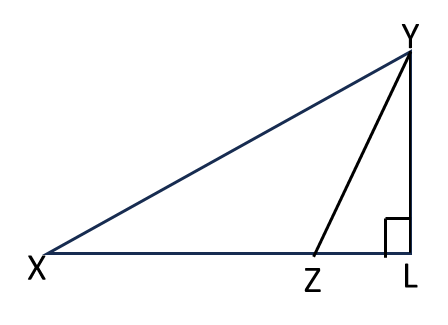
-
Solutions to Ex. 6.4
Q1. Is it possible to have a triangle with the following sides?
Ans:
(i) The sum of two sides is,
2 + 3 = 5cm
Third side = 5 cm
As, the sum of the length two sides is not greater than the length of the third side.
This triangle is not possible.
(ii) Sum of any two sides,
3 + 6 >7
3 + 7 > 6 &
7 + 6 > 3
As, the sum of the length of any two sides is greater than the length of the third side.
This triangle is possible.
(iii) Sum of any two sides,
3 + 2 = 5cm which is less than 6cm
As, the sum of the length two sides is not greater than the length of the third side.
This triangle is not possible.
Q2. Take any point O in the interior of a triangle PQR. Is
Ans:
(i) OP, OQ & PQ are sides of ∆OPQ.
The sum of the length of two sides of a triangles is always greater than the length of the third side.
Yes, OP + OQ > PQ
(ii) OQ, OR & QR are sides of ∆OQR.
The sum of the length of two sides of a triangles is always greater than the length of the third side.
Yes, OQ + OR > QR
(iii) OP, OR & RP are sides of ∆OPR.
The sum of the length of two sides of a triangles is always greater than the length of the third side.
Yes, OR + OP > RP
Q3. AM is a median of a triangle ABC. Is AB + BC + CA > 2 AM?
Ans:
As the sum of the length of two sides of a triangle is always greater than the length of the third side,
So, in ∆ABM,
AB + BM > AM ...... (1)
So, in ∆ACM,
AC + CM > AM ....... (2)
Adding equations (1) & (2),
AB + BM +AC +CM > 2AM
As, BM + CM = BC
AB + BC + CA > 2AM is proved
Q4. ABCD is a quadrilateral. Is AB + BC + CD + DA > AC + BD?
Ans:
As the sum of the length of two sides of a triangle is always greater than the length of the third side,
In ΔABC,
AB + BC > AC ...... (1)
In ΔCDA,
CD + DA > AC ....... (2)
In ΔBCD,
BC + CD > BD ....... (3)
In ΔBAD,
AB + DA > BD ...... (4)
Adding equations 1, 2, 3 & 4,
2 (AB + BC + CD + DA) > 2(AC + BD)
Dividing both sides by 2
AB + BC + CD + DA > AC + BD
Q5. ABCD is quadrilateral. Is AB + BC + CD + DA < 2 (AC + BD)
Ans:
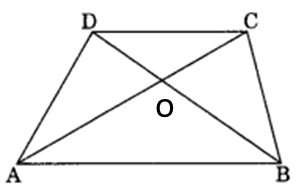
As the sum of the length of two sides of a triangle is always greater than the length of the third side,
In ΔAOB,
AO + OB > AB ...... (1)
In ΔBOC,
BO + OC > BC ....... (2)
In ΔCDO,
CO + OD > CD ....... (3)
In ΔADO,
AO + OD > DA ...... (4)
Adding equations 1, 2, 3 & 4,
AO + OB + BO + OC + CO + OD + AO + OD > AB + BC + CD + DA
2(AO + OC) + 2(BO +OD) > AB + BC + CD + DA
2AC + 2BD > AB + BC + CD + DA
2 (AC + BD) > AB + BC + CD + DA
Q6. The lengths of two sides of a triangle are 12 cm and 15 cm. Between what two measures should the length of the third side fall?
Ans:
Given: Length of two sides = 12cm, 15cm
As the sum of length of two sides of a triangle is always greater than the length of the third side,
12 + 15 = 27
Hence, the third side has to be less than 27cm.
The third side has to be greater than difference of the length of the two sides,
15 - 12 = 3
The third side has to be greater than 3cm and less than 27cm.
-
Solutions to Ex. 6.5
Q1. PQR is a triangle, right-angled at P. If PQ = 10 cm and PR = 24 cm, find QR
Ans: ∆PQR is a right angled triangle,
By Pythagoras property,
PQ2 + PR2 = QR2
102 + 242 = QR2
QR2 = 100 + 576 = 676
QR = 26cm
Q2. ABC is a triangle, right-angled at C. If AB = 25 cm and AC = 7 cm, find BC.
Ans:
∆ABC is a right angled triangle,
By Pythagoras property,
AC2 + BC2 = AB2
72 + BC2 = 252
BC2 = 625 - 49 = 576
= \( \sqrt[2]{576} \)
BC = 24cm
Q3. A 15 m long ladder reached a window 12 m high from the ground on placing it against a wall at a distance a. Find the distance of the foot of the ladder from the wall.
Ans:
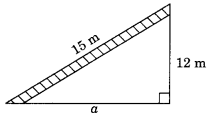
By Pythagoras property,
a2 + 122 = 152
a2 + 144 = 225
a2 = 225 -144 = 81
a = 9m
The distance of the foot of the ladder from the wall is 9m.
Q4. Which of the following can be the sides of a right triangle? In the case of right-angled triangles, identify the right angles.
Ans:
(i) 2.5 cm, 6.5 cm, 6 cm.
6.52 = 42.25
2.52 + 62 = 6.25 + 36 = 42.25
Thus, 2.52 + 62 = 6.52
As, Pythagoras property holds true,
This is a right angled triangle.
The right angle is the angle opposite to the 6.5cm side (hypotenuse).
(ii) 2 cm, 2 cm, 5 cm
52 = 25
22 + 22 = 4 + 4 = 8
Thus, 22 + 22 \( \neq \) 52
This cannot be a right angled triangle.
(iii) 1.5 cm, 2cm, 2.5 cm
2.52 = 6.25
1.52 + 22 = 2.25 + 4 = 6.25
Thus, 1.52 + 22 = 2.52
As, Pythagoras property holds true,
This is a right angled triangle.
The right angle is the angle opposite to the 2.5cm side (hypotenuse).
Q5. A tree is broken at a height of 5 m from the ground and its top touches the ground at a distance of 12 m from the base of the tree. Find the original height of the tree.
Ans:
Given: Height at which tree is cut (AC) = 5cm
Distance from base (AB) = 12m
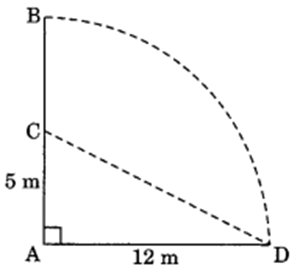
By Pythagoras property,
AC2 + AD2 = CD2
52 + 122 = CD2
CD2 = 25 + 144 = 169
CD = 13m = BC
Height of the tree = AC + BC
= 5 + 13 = 18m
Original height of the tree is 18m.
Q6. Angles Q and R of a ∆PQR are 25º and 65º. Write which of the following is true:
Ans:
By angle sum property of a triangle,
∠P + ∠Q + ∠R = 180º
∠P + 25º + 65º = 180º
∠P = 180º - 90º = 90º
Thus, ∆PQR is a right angled triangle,
By Pythagoras property,
(i) PQ2 + QR2 = RP2 is not true.
(ii) PQ2 + RP2 = QR2 is true.
(iii) RP2 + QR2 = PQ2 is not true.
Q7. Find the perimeter of the rectangle whose length is 40 cm and a diagonal is 41 cm.
Ans:
Given: Length (AB) = 40cm
Diagonal (AC) = 41cm
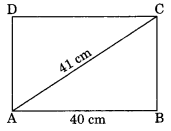
As ∠B = 90º,
By Pythagoras property,
AB2 + BC2 = AC2
402 + BC2 = 412
BC2 = 1681 - 1600 = 81
BC = 9cm
The breadth of the rectangle is 9cm.
Perimeter = 2 (l + b)
= 2 (40 + 9) = 2 x 49
Perimeter = 98cm
Q8. The diagonals of a rhombus measure 16 cm and 30 cm. Find its perimeter.
Ans:
Given: Diagonal AC = 16cm
Diagonal BD = 30cm
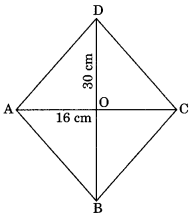
The diagonals of rhombus bisect & are perpendicular to each other at O.AO = 16/2 = 8cm
OD = 30/2 = 15cm
∆AOD is a right angled triangle,
By Pythagoras property,
AO2 + OD2 = AD2
82 + 152 = AD2
AD2 = 64 + 225 = 289
AD = 17
Side of the rhombus = 17cm
Perimeter = 4 x 17 = 68cm
The perimeter of rhombus is 68cm.
-