
8. Adjectives

Section outline
-
Adjectives are words that describe a noun or a pronoun.
Features:
- They are descriptive words.
- They modify the noun or pronoun.
- They give us more information of the noun or pronoun.
Examples:
- He is a tall boy.
- Jane has attractive eyes.
Adjectives ‘tall & attractive’ describe 'the boys’ height & Jane's eyes'.
-
There are seven types of adjectives.
They are:
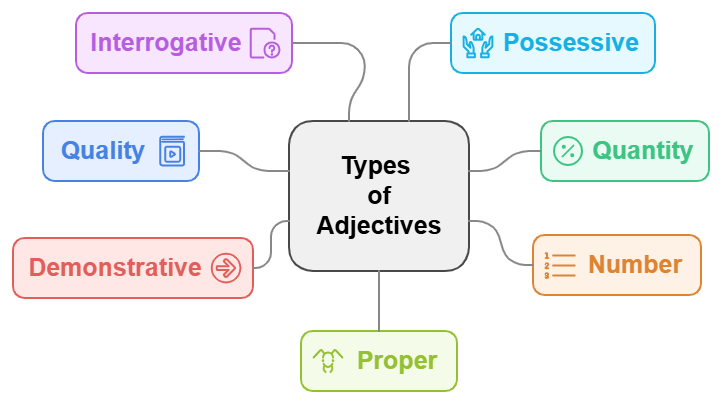
Let's understand each type in detail.
-
Adjective of Quality describes the quality or characteristics of a person or thing.
Features:
- It describes the appearance, size, shape, color, or nature of a person or thing.
- Helps to specify what kind of person, place, or thing is being referred.
- It provides more information about how the noun is.
Examples:
Tall man, cruel witch, soft fabric, rich family, hot tea, etc.
Adjective of Quality describes:
Quality Examples Appearance beautiful, ugly, etc. Size tall, small, big, etc. Colour red, blue, etc. Shape curves, round, flat, etc. Texture shiny, rough, etc. Character kind, cruel, brave, honest, etc. Condition broken, old, fresh, clean, etc. Sensory sour, sweet, soft, loud, etc. Emotions happy, sad, excited, etc. Status rich, poor, wealthy, etc. -
Adjective of Quantity specify quantity of uncountable nouns.
Features:
- It answers the question 'how much'.
- It is a measuring word.
- It is used with uncountable nouns.
- It provides vague or approximate quantity.
Examples:
little rice, some water, enough milk, etc.
-
Adjective of Number indicates the number or order of countable nouns.
Examples:
five children, ten books, several people, forty thieves, etc.
Features:
- It answers the question 'how many or in what order'.
- It provides clarity on quantity or sequence.
- It makes descriptions more precise.
There are three types of adjectives of number:
1. Definite Numeral Adjectives:
They indicate the exact number or position of the person or thing.
There are two types:
a. Cardinal Adjectives:
-
- It shows exact number.
- Eg: Ten boys, five pens.
- It answers the question 'how many'.
b. Ordinal Adjectives:
-
- It shows exact position.
- Eg: first prize, second seat, fifth boy, etc.
- It answers the question 'in what order'.
2. Indefinite Numeral Adjectives:
They refer a quantity of countable noun which is not exact in number.
Examples:
Few people, several books, etc.
3. Distributive Numeral Adjectives:
They refer nouns as individual members of a whole group.
Examples:
Each student, every paper, etc.
-
Demonstrative Adjectives point out specific person or thing.
Features:
- It answers the question 'which one / ones.'
- It indicates the position of the noun relative to the speaker.
- It is always followed by a noun.
Demonstrative Adjectives are:
That, this, these, those, such & certain.
For Number Adjective Examples Things near Singular this This book is interesting. Plural these These apples are fresh. Things away Singular that That mountain looks tall. Plural those These walls are not painted. -
Interrogative Adjectives are used to ask questions.
Features:
- It is placed before the noun.
- It helps to enquire about the noun.
Interrogative Adjectives are:
Adjective Ask about Examples Whose ownership Whose dress is this? What kind or type of thing. What color is your dress? Which specific item or group of items Which dress is yours? -
Possessive Adjectives show ownership or possession or belonging.
Features:
- It answers the question 'whose'.
- It is always followed by a noun.
Singular possessive adjectives are:
Person Adjective Examples First my This is my dress. Second your Is this your shoes? Third (male) his This is his story. Third (female) hers Her bag is full. Third (neuter) its Its tail is small. Plural possessive adjectives are:
Person Adjective Examples First our Our car is new. Second your Your dress is pretty. Third their Their garden is beautiful. -
Proper Adjective is derived from proper nouns.
Features:
- It describes specific people, places, or things.
- It begins with a capital letter.
- It often indicates nationality, religion, or specific locations.
Examples:
We love Chinese cuisine.
Jane loves American music.
-
Adjectives are formed by adding different suffixes to words.
Examples:
attract + ive = attractive
beauty + ful = beautiful
List of common suffixes to form adjectives:
Suffixes Some Examples y dirty, noisy ly lonely, lively less useless, careless ful dutiful, careful ive impressive, active ing caring, matching able adorable, valuable al national, musical ish foolish, childish en wooden, broken ible terrible, horrible ous famous, poisonous ar circular, tabular ic poetic, heroic some tiresome -
Degrees of Comparison show the strength of the adjective.
Features:
- They are used to compare a noun or pronoun with another.
- Adjectives change form to show different degrees of comparison.
- Only adjectives of quality have degrees of comparison.
Three types of degree of comparison are:
1. Positive Degree:
Positive Degree is used when there is no comparison.
Example:
Tom is a tall boy.
2. Comparative Degree:
Comparative degree is used to compare between two nouns or pronouns.
Example:
Tom is taller than Sam.
The word 'than' is used after the adjective in comparative degree.
Exception:
Adjectives ending with 'or' like senior, inferior, etc. are followed by 'to' & not 'than'.
Example:
He was junior to me in school.
3. Superlative Degree:
Superlative degree is used to compare more than two nouns or pronouns.
Example:
Tom is the tallest boy in his class.
The article 'the' is used before the adjective in superlative degree.
-
1. For most common adjectives:
Add 'er' & 'est'.
Positive Comparative Superlative thick thicker thickest cheap cheaper cheapest small smaller smallest 2. For adjectives ending in 'e':
Add 'r' & 'st'.
Positive Comparative Superlative wide wider widest brave braver bravest large larger largest 3. For adjectives ending with a vowel followed by consonant:
Double the last letter & add 'er' & 'est'.
Positive Comparative Superlative big bigger biggest fit fitter fittest sad sadder saddest 4. Adjectives ending with a consonant & 'y';
Remove 'y' & add 'ier' & 'iest'.
Positive Comparative Superlative easy easier easiest pretty prettier prettiest lazy lazier laziest 5. Some adjectives ending with ‘ful’, ‘ing’, ‘tive’, ‘ous’, ‘able’, 'ent', etc.:
Add 'more' & 'most' to the positive degree.
Positive Comparative Superlative beautiful more beautiful most beautiful intelligent more intelligent most intelligent attractive more attractive most attractive 6. No rule
Positive Comparative Superlative good / well better best bad, ill, evil worse worst little / few less least many / much more most far farther farthest later latter latest / last -
There are some adjectives which we use daily.
For effective spoken & written English, we should now their correct use.
1. Many:
- Used with plural countable nouns.
- Denotes large quantity.
- Eg.: many boxes, many years, etc.
2. Much:
- Used with uncountable nouns.
- Denotes large quantity.
- Eg.: much happiness, much thrill, etc.
3. Some:
- Used when affirmative answer is expected.
- Eg.: Could you make some coffee?
4. Any
- Used when negative answer is expected.
- Eg.: I can't eat any more pie.
5. Little:
- Used with uncountable nouns.
- It indicates almost none.
- Eg.: There is little water in the jug.
6. A little:
- Indicates at least some.
- Eg.: There is a little water in the jug to make a cup of tea.
7. The little:
- Indicates whole, though very little.
- Eg.: She made two cups of tea with the little water in the jug.
8. Few:
- Used with countable nouns.
- It indicates almost none.
- Eg.: Few students attended the class yesterday.
9. A few:
- Indicates at least some.
- Eg.: A few students attended the class today.
10. The few:
- Indicates most of them, though very few.
- Eg.: The few students who attended the class today, finished their worksheets.
11. Later & latest:
- Refers to time.
- Eg.: The latest events were a hit.
12. Latter & last:
- Refers to position.
- Eg.: The last boy submitted his paper.
-
In this course, we learn't:
- Adjectives are descriptive words that complete the nouns.
- Types of Adjectives:
Type Adjectives Quality cruel, old, tall Quantity few, some, much Number several, three Demonstrative that, this, these, those Interrogative whose, what & which Possessive my, your, our, his Proper Indian, Asian, Italian - Degrees of Comparison & its rules:
Adjective Rule Most common Add 'er' & 'est' Ending in 'e' Add 'r' & 'st' Ending with a vowel followed by consonant Double the last letter & add 'er' & 'est'. Ending with a consonant & 'y' Remove 'y' & add 'ier' & 'iest' Some endings: ‘ful’, ‘ing’, ‘tive’, etc. Add 'more' & 'most' No rule Remember table
In the next course, we will learn about verbs, the backbone of a sentence!