
6. Pronouns

Section outline
-
Pronouns are words used in the place of nouns.
Example:
Rita is going to school. Rita will come back by afternoon.
Here, the noun 'Rita' is used repeatedly.
Hence, we substitute it with the pronoun 'she' in the second sentence.
Rita is going to school. She will come back by afternoon.
Thus, pronouns:
- Convey the same meaning as the original noun.
- Help in shortening the sentence by avoiding repetition.
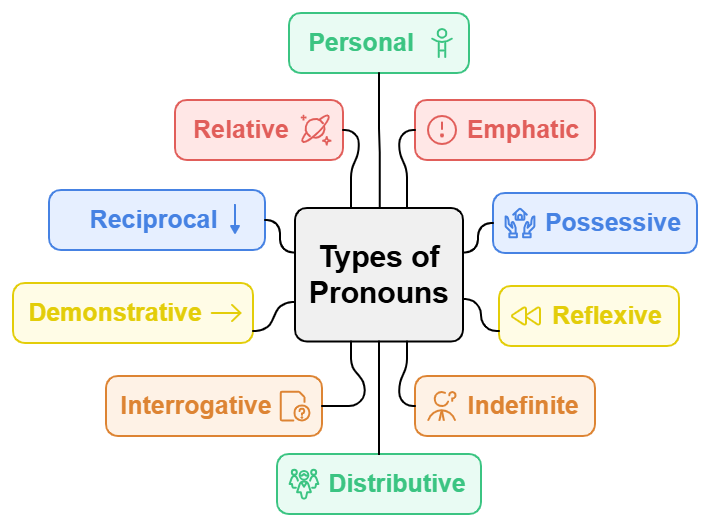
There are 10 different kinds of Pronouns.
-
Personal Pronoun stands for people or objects.
Use of personal pronouns depends on:
- Type of noun.
- Gender of noun.
- Number (singular or plural).
Personal Pronoun is of two types:
- Subject Pronoun.
- Object Pronoun.
-
Possessive pronoun is used to show ownership or possession.
Singular possessive pronouns are:
Person Pronoun Examples First my, mine This is my book.
This pencil is mine.
Second your Is this pencil yours? Third (male) his This story is his. Third (female) hers This bag is hers. Third (neuter) its The cat licked its paws. Plural possessive pronouns are as follows:
Person Pronoun Examples First our, ours That house is ours. Second yours These books are yours. Third their, theirs The garden is theirs. -
Reflexive pronoun is used when the action done by the subject reflects upon the subject.
Thus in Reflexive pronouns, the subject & object are the same person or thing.
Singular reflexive pronouns are:
Person Pronoun Examples First myself I made this card myself. Second yourself You might cut yourself with the knife. Third (male) himself He wrote the poem himself. Third (female) herself She herself cooked the entire dinner. Third (neuter) itself The cat went itself in the tub. Plural reflexive pronouns are:
Person Pronoun Examples First ourselves We organized this picnic all by ourselves. Second yourselves Children, find a seat for yourselves. Third (male) themselves They themselves cleaned the house. -
Interrogative Pronouns replace the noun in the sentence to ask question.
Interrogative Pronouns are as follows:
Pronoun Ask questions about Examples Who people as subject Who is coming to the mall? Whom people as subject or object Whom is he talking to? Whose people to show possession Whose book is this? What things or animals What do you want? Which people or things for choice Which of the books have you read? -
Demonstrative Pronouns are used to show or point out specific people or things they replace.
Demonstrative Pronouns are as follows:
For Number Pronoun Examples Things near Singular this This is a good restaurant. Plural these These are fresh. Things away Singular that That is a huge waterfall. Plural those Those are not mine. 'This' & 'that' are also used to refer to something that is already spoken earlier.
Example:
The principal gave a welcome speech. All the students liked that.
Here, that refers to the speech.
-
Indefinite Pronouns refer to general person or thing rather than anything specific.
Indefinite Pronouns are as follows:
Type Indefinite Pronouns Examples Person everyone, everybody, somebody, someone, no one, nobody, anyone, anybody
Everyone is going on a holiday.
Nobody came to the party.
Place everywhere, somewhere, nowhere, anywhere
The toy was nowhere to be found.
We can go anywhere for a vacation.
Thing everything, something, nothing, anything
Everything is in such a big mess.
He got nothing for his talent.
Quantity one, few, several, many, little, much, less, plenty, most, more
Only few got admissions this year.
Several came to clean the beach.
-
Relative Pronouns join sentences which speak about the same person or thing.
Features:
- They relate back to a noun or pronoun i.e. the antecedent subject of the sentence.
- They introduce a relative clause & connect it to independent clause in the sentence.
- To provide more information of the subject of the sentence.
Relative Pronouns are as follows:
Relative Pronoun Use Examples Who relates to the subject noun / pronoun This is the man who stole the statues. Whom relates to object noun / pronoun My sister whom you met at the party, is going to college this year. Whose shows possession or ownership This is the artist whose painting sold at the auction. Which gives non-essential information The tea which we had now, was refreshing. That gives important information This is the painting that won the first prize. -
Emphatic Pronoun emphasizes the noun or pronoun in the sentence.
It has the same form as reflexive pronouns.
Examples:
He himself built the tree house.
Jane herself cooked the dinner.
They themselves removed the fencing.
-
Distributive Pronouns refer to persons or objects one at a time.
Distributive pronouns are each, either & neither.
Examples:
Each child got a book to read.
You can take either of the sweets.
Neither of the dresses fit me.
-
Reciprocal Pronouns refers to a relationship between two or more people or things.
Reciprocal pronouns are used when two or more people do an action & get affected by the result at the same time.
Reciprocal Pronouns are:
- Each other &
- One another
Each other is used when only two people are involved.
One another is used when more than two people are involved.
Examples:
All the teams should help one another.
Sam and Tom helped each other.
-
Let's summarize all the pronouns we learn't in this course:
1. Singular Pronouns:
Person Pronouns Subject Object Possessive Reflexive First I me mine myself Second you you yours yourself Third (male) he him his himself Third (female) she her hers herself Third (neutral) it it its itself 2. Plural Pronouns:
Person Pronouns Subject Object Possessive Reflexive First we us ours ourselves Second you you yours yourselves Third they them theirs themselves 3. Other Pronouns:
Type of Pronoun Pronouns Interrogative who, whom, whose, what, which Demonstrative this, these, that, those Indefinite everyone, nothing, several, few, etc. Distributive each, either, neither Reciprocal each other, one another 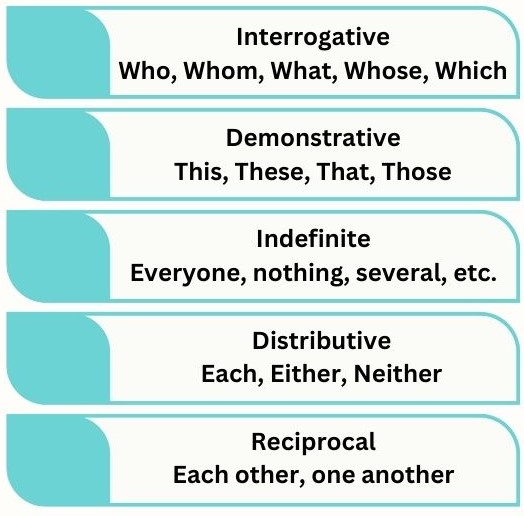
In the next course, we will learn about articles.